Galactic Development
Galactic Development
An idle empire game that runs whether you are watching or not.
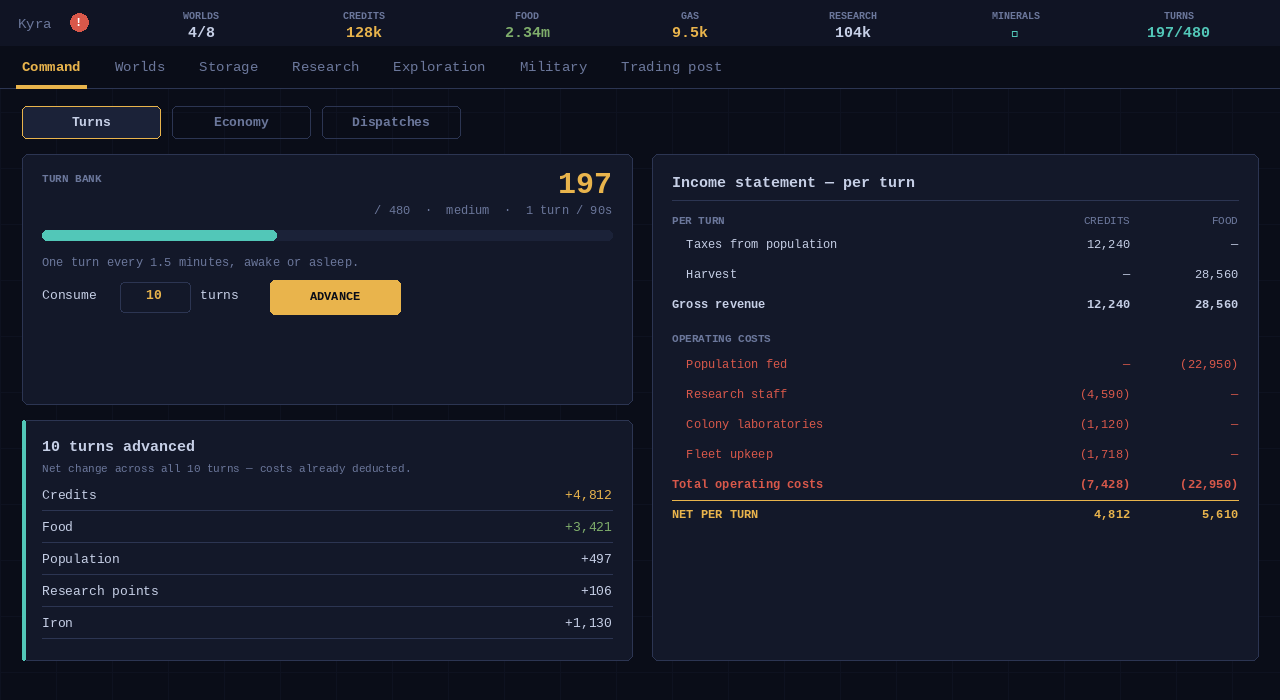
You start with one world, five hundred people, and a system nobody has surveyed. Turns arrive on their own — every minute, ninety seconds, or four minutes, depending on the rhythm you choose — and they keep arriving while the tab is closed. Come back in an hour or a fortnight and your farms have been running, your yards have been building, and your prospectors have come home.
Choose how time flows
Before anything else you pick an energy mode, and it changes how you play rather than how fast you win:
| Mode | A turn every | Banked while away |
|---|---|---|
| Heavy | 60 seconds | 2 hours |
| Medium | 90 seconds | 12 hours |
| Low | 4 minutes | 14 days |
Heavy suits someone who checks in through the day. Low lets you vanish for a fortnight and lose nothing. Changeable once a week.
People have to live somewhere
Population is the engine of everything — and it does not grow past the room you have built for it. Every world holds a few thousand souls in prefabs until you start building Habitation Blocks, and each level triples what that world can hold. A fully developed world houses twenty billion people.
Your empire fills the space it has, then stops and waits for you. That plateau is the game: it turns idle time into a decision.
A settled world houses almost nobody until you build there, so expansion is a commitment rather than a free multiplier — and a world of twenty billion spends most of its effort on itself, so a vast empire is powerful without being infinite.
Build a world, then a system, then an empire
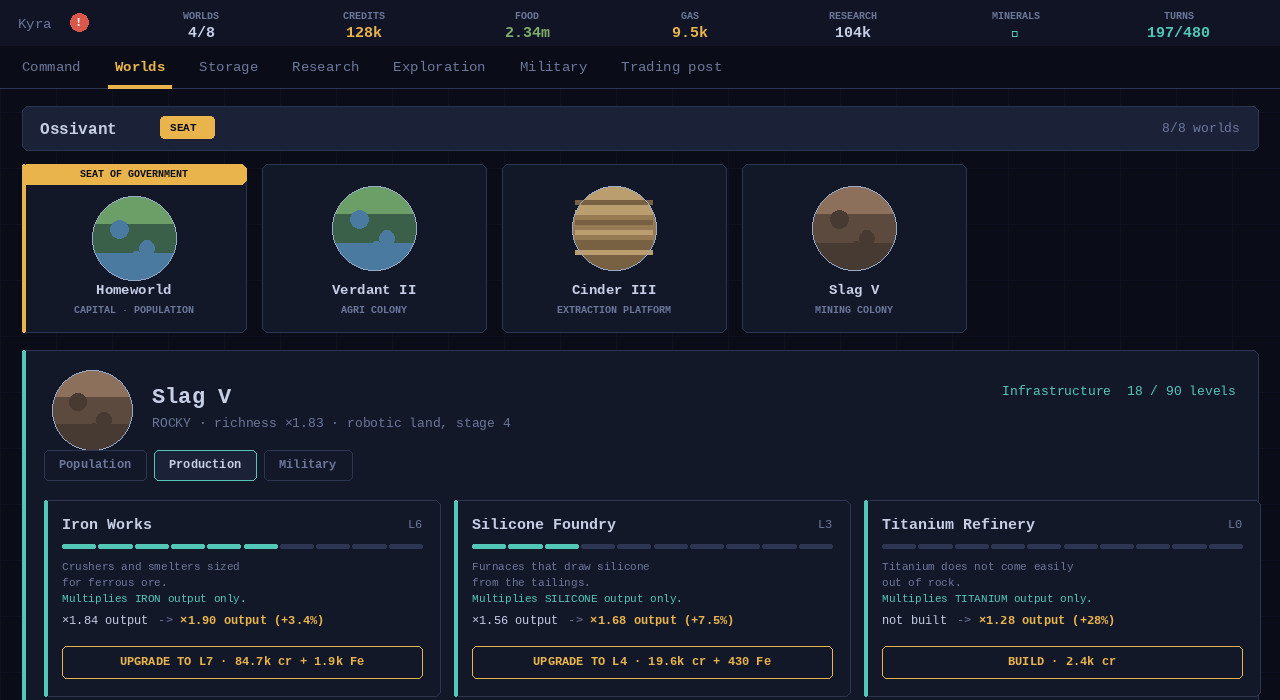
Every colonised world carries nine independent buildings, each ten levels deep, grouped by what they do:
- Population — Habitation Blocks, Hydroponics Bays, Administration
- Production — a separate works for every mineral: Iron Works, Silicone Foundry, Titanium Refinery, Hydrocarbon Cracker, Agri Domes
- Military — Perimeter Batteries and Bunker Networks
Because each mineral has its own works, worlds specialise. Every world tells you how well it suits its role, and every upgrade states its arithmetic plainly: ×1.84 output → ×1.90 output (+3.4%).
Commanders
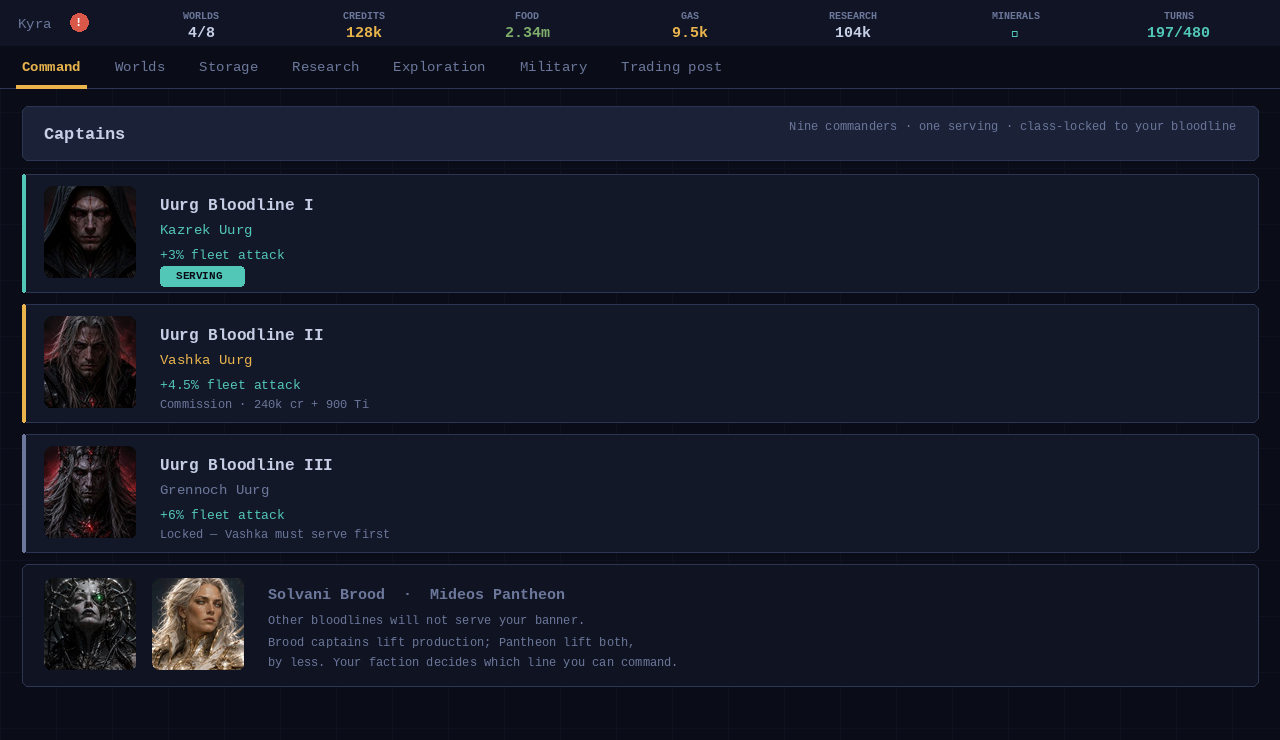
Nine captains across three bloodlines — Uurg raiders, Solvani Brood producers, Mideos Pantheon who lift both by less. One serves at a time, class-locked to your faction, and each tier must earn the next: Vashka will not take the banner until Kazrek has held it. Tap a rival on the map and you see who commands for them.
A galaxy that moves
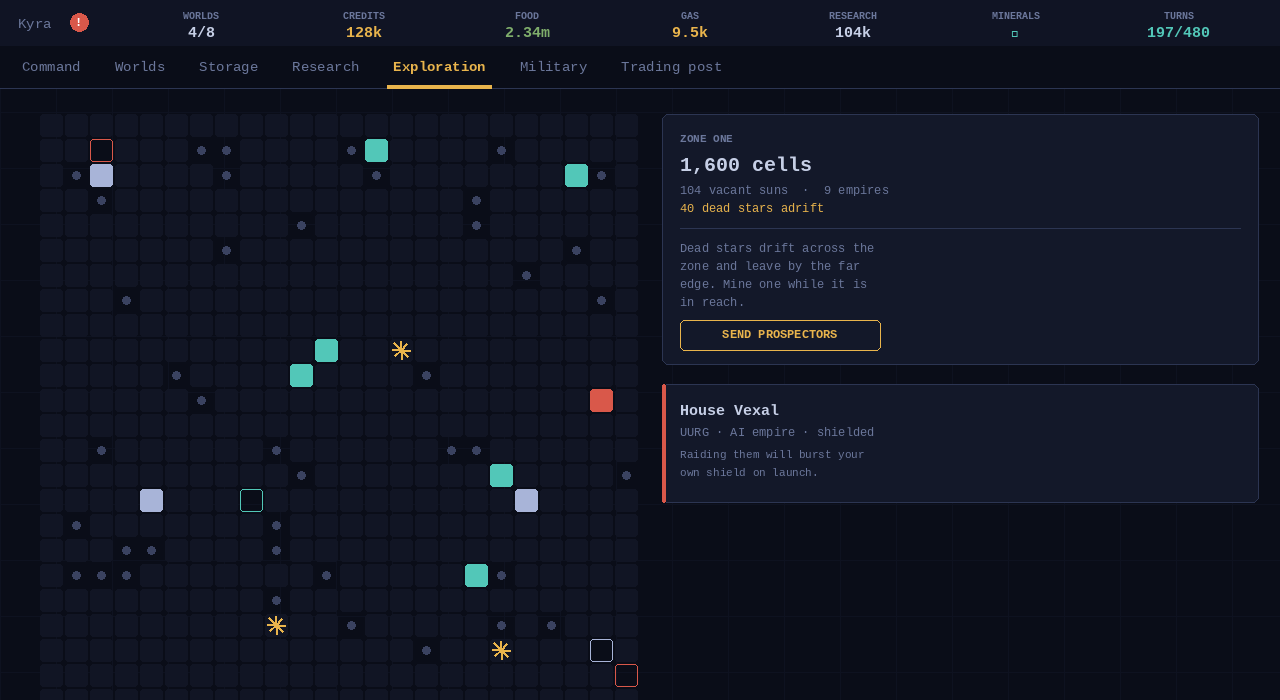
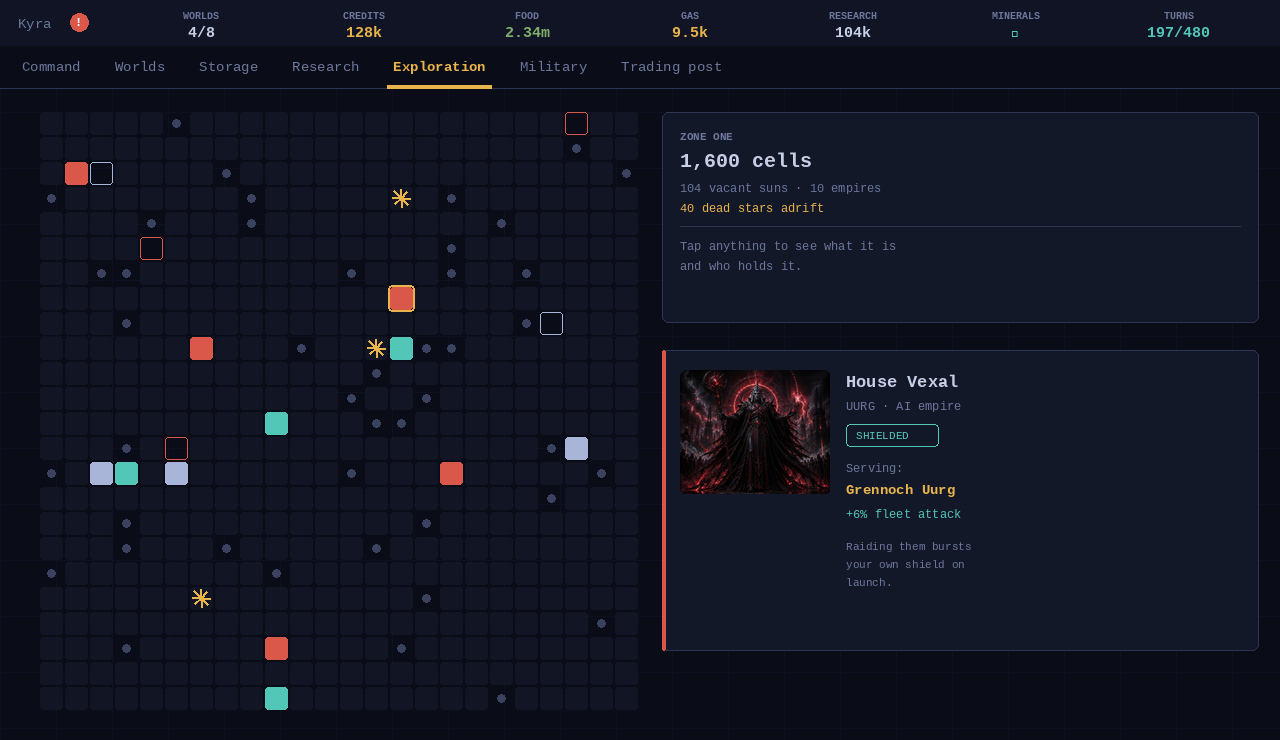
Zone One is 1,600 cells holding vacant suns, rival empires, and dead stars that drift — entering at one edge, crossing, and leaving by the other. Lonsdaleite exists nowhere else, so a rich one passing near your systems is a window, not a fixture.
Tap anything and it tells you what it is and who holds it.
Research that never solves itself
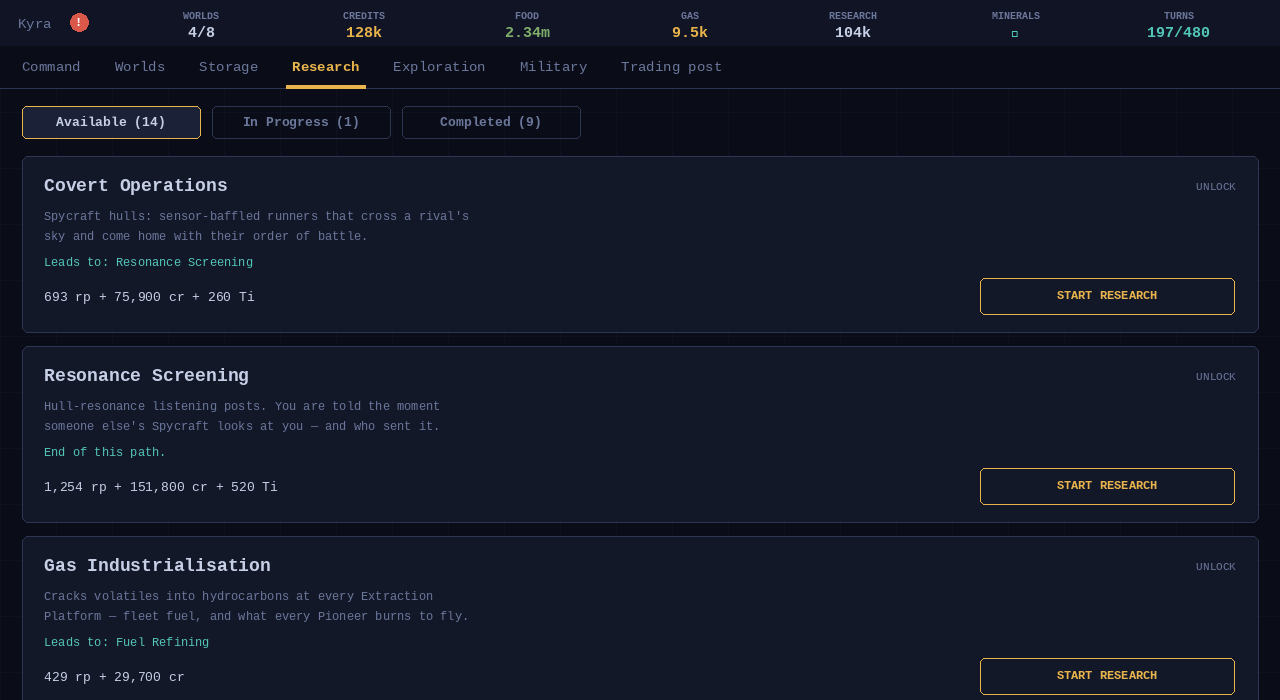
Twenty-five technologies on a tree that hides what you have not earned. Costs climb faster than your economy does, so the tree stays a ladder rather than a checklist.
The intelligence branch runs deep: Covert Operations unlocks the Spycraft, a sensor-baffled hull that crosses a rival's sky and comes home with their order of battle. Resonance Screening tells you the moment someone runs one over your systems — and who sent it.
War is expensive, defence is cheaper
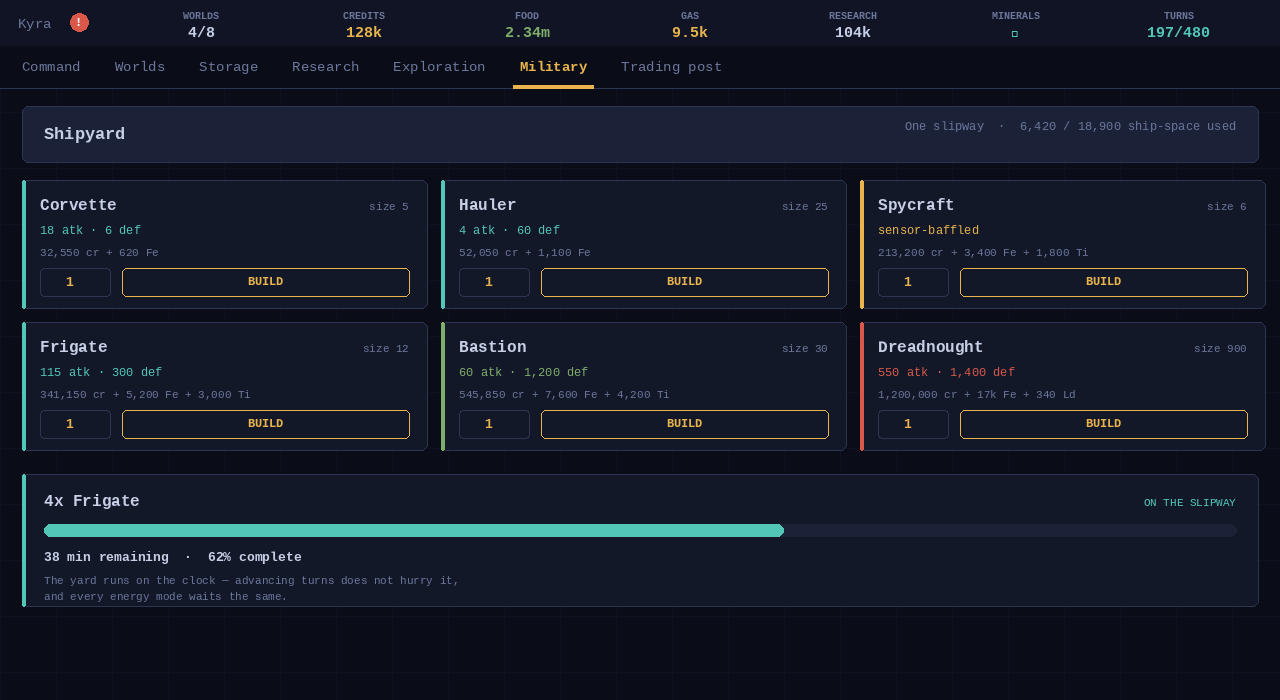
Ships run an exponential ladder from a 20,000-credit freighter to a 1.2 million credit Dreadnought. Nothing in the yard is loose change, and the yard runs on the wall clock — every energy mode waits the same for the same hull.
Defence is deliberately four times cheaper per point than attack, across hulls, batteries and shields alike. Holding ground is the affordable option; taking someone else's is the expensive one. Raids loot credits and every mineral, limited by what your hulls can carry, and a bunker network means a raider leaves with less than they came for.
Buy a 24-hour protection shield and nobody can touch you — until you throw the first punch, which bursts it instantly.
Built for the phone in your pocket
Every screen works one-handed and opens up on a desktop: the same card-based interface at both ends, larger type and multiple columns where there is room.
Also in here
- Three factions with real trade-offs — raiders, producers, and a hybrid good at neither and bad at nothing
- A global trading post shared by every empire on the server, where prices fall as the store fills and recover over time
- Warehouses with real ceilings — production past the cap is lost
- Fallen empires leave a corpse on the map for a week: claimable systems, intact worlds, and none of their research
- A two-minute introduction for new commanders, and a delete button for when you want to start over
Free. No ads, no energy meters to buy your way past. Just an empire that keeps working while you get on with your day.
Leave a comment
Log in with itch.io to leave a comment.